

Going Up: How to Turn a Setback Into a Success Story


If it’s our business to pursue something (and it is), then we will inevitably face setbacks. There’s no river yet discovered without a bend or a curve somewhere along the way, and when we travel on the river of desire, the twists and turns are every bit as important as the final destination.
But there will always be moments that are stuck in our craw, revisited in our nightmares, and leave us wondering what could have been. It is our challenge to come to terms with the circuitous nature of failure before we become caught in its loop.
Therapy and counseling can help you to face the emotional reality of these setbacks with maturity and competence, if you can find the right person to guide you. Let’s learn how therapy can free us from the fear of potential setbacks and let setbacks unlock our true potential.
How Does A Setback Affect Us Psychologically?

When we experience a setback, we are less likely to self-regulate and more likely to experience yet another setback. These moments of poor regulation are what can cause a small setback to snowball into an instance of major distress.
Our feelings might be too intense for our circumstances, but they often arise from instincts that are valid and real. Whether we are ignoring them, or letting them hijack our decision-making, we are not truly facing these setbacks until we honestly appraise them and accept the feelings that arise from them.
- You might feel discouraged and depressed.
- You could become anxious over the potential of a future setback.
- You may notice yourself socially isolating and retreating within to feel safe.
How Can Therapy Help With A Big Setback?

Your therapist can be a steady, grounded presence at a time when everything else feels uncertain. After a setback, it’s common for your thoughts to become louder, more critical, and less accurate. A therapist helps you slow that process down.
What makes therapy particularly effective is that it meets you where you are. Whether the setback is personal, professional, or something harder to define, therapy adapts to the shape of your experience. It gives you both structure and flexibility: structure to make sense of what happened, and flexibility to rebuild in a way that actually fits your life.
- Therapy Is Often The Best Depression Treatment. When energy and motivation have become a going concern, therapy is a great option for relief. We cannot control everything, but we can control our reaction to anything. A good therapist will motivate you to move beyond depression and develop a deeper connection with yourself and the world around you.
- Counseling Can Bring Anxiety Relief When Nothing Else Has Worked. Anxiety grows in the space where confidence used to be. You might find yourself overthinking decisions, hesitating to take risks, or expecting things to go wrong before they even begin. The right therapist can help you interrupt those unhelpful patterns of thought and unchain yourself from the shackles of anxiety. When we hear our anxieties out loud and have them reflected back to us, they start to lose their power over us. Shadows need to be brought into the light and examined with the help of a nonjudgmental guide.
- Group Therapy Can Help You Open Up To Others Again. One of the quieter effects of a setback is disconnection. You may withdraw from others, either because you don’t want to explain what happened or because it feels safer to keep your distance. Over time, that isolation can make the setback feel even heavier. Group therapy is a safe place where you can open up to others again without fear of dishonesty, poor timing, or retribution.
Who Can I Go To For Therapy In St. Petersburg?
Mandi Rogers is a therapy intern in St Petersburg, FL, who can help you move beyond your current situation. If something is changing in your life, whether it’s a “good” change or a “bad” change, you might feel anxious, depressed, overwhelmed, or that feeling of being out of your depth. While change can be beautiful, it can also be very frightening if you feel like you don’t know what your doing or where you’re going.
Sudden changes that you didn’t plan for can feel like setbacks. It might feel like everything has fallen apart.
Mandi can give you the tools to pick up the pieces and keep making progress.
This is the wisdom she has to offer when it comes to facing setbacks with calmness and dignity:
How Does A Therapist Help You Process Setbacks?

There is a moment after a setback that feels strangely quiet.
The email arrives.
The plan falls apart.
The relationship ends.
The opportunity disappears.
And suddenly you are sitting there thinking: “Well… that didn’t go the way I imagined.”
Setbacks have a way of convincing us that we are moving backward. Our brain quickly jumps in with a dramatic narration: Great, another failure. Fantastic. Add it to the list.
But here is the funny thing about setbacks. Many of the best success stories actually start with one.
Michael Jordan didn’t make his high school varsity basketball team.
Oprah Winfrey was fired from her first TV job because a producer said she was “unfit for television.”
Steve Jobs was fired from the company he started before returning years later to lead its most innovative era.
Thomas Edison once said, “I have not failed. I’ve just found 10,000 ways that won’t work.”
I’m not here to tell you that you need 10,000 setbacks before you can consider yourself a success story. But know this: every setback you encounter is an opportunity to pivot toward success.
The problem is that when you are in the middle of it, it feels less like the beginning of a comeback and more like the opening scene of a disaster movie.
The truth is that setbacks are often less about failure and more about interruption. Life hits the pause button and suddenly you have space you did not ask for. Space to rethink, recalibrate, and question what you were doing in the first place.
It is uncomfortable. But it is also where growth and creativity sneak in.
When something goes wrong, our instinct is to ask a very unhelpful question: Why is this happening to me? That question usually leads to dramatic conclusions about our intelligence, our competence, or our entire life trajectory.
A better question is: What can I learn from this?
That shift may seem small, but it changes everything. Instead of turning the setback into evidence that you are failing at life, it becomes information. Information about what works, what does not work, and what might need to change.
Think about almost any impressive success story and you will find a plot twist somewhere along the way.
A rejection. A failed attempt. A moment when things looked like they were heading downhill. Those moments are rarely the end of the story. They are usually the moment the story changes direction.
Of course, before the inspirational lesson kicks in, there is usually a phase where you feel annoyed, disappointed, or mildly dramatic about the whole situation. That part is normal. Feeling frustrated does not mean you are doing setbacks wrong. It means you are human.
The important part is what happens next.
The people who eventually turn setbacks into success stories tend to do three things.
- First, they allow themselves to feel disappointment instead of pretending everything is fine. Ignoring emotions does not make them disappear. It just turns them into emotional clutter that shows up later in inconvenient ways.
- Second, they treat the setback like useful feedback. Maybe it revealed a boundary that needs to be set. Maybe it showed that a certain path was not the right one. Maybe it pushed them toward something better they had not considered yet.
- And third, they take one small step forward. Not a huge dramatic comeback. Just a small move in the right direction.
Progress usually returns quietly.
Another application sent.
Another idea explored.
Another conversation started.
Momentum rebuilds itself one step at a time.
When people look back years later, the setback that once felt like a disaster often looks very different. It becomes the moment where things started to shift. The pivot point. The chapter where the plot got interesting.
Moving upward in life does not mean avoiding mistakes or hard seasons. It means learning how to use those moments as part of the climb.
So, if something recently did not go the way you hoped, take a breath. You might not be going backward after all.
You might just be at the beginning of the part of the story where things start going up.
Where Can I Get Group Therapy In St Petersburg, FL?
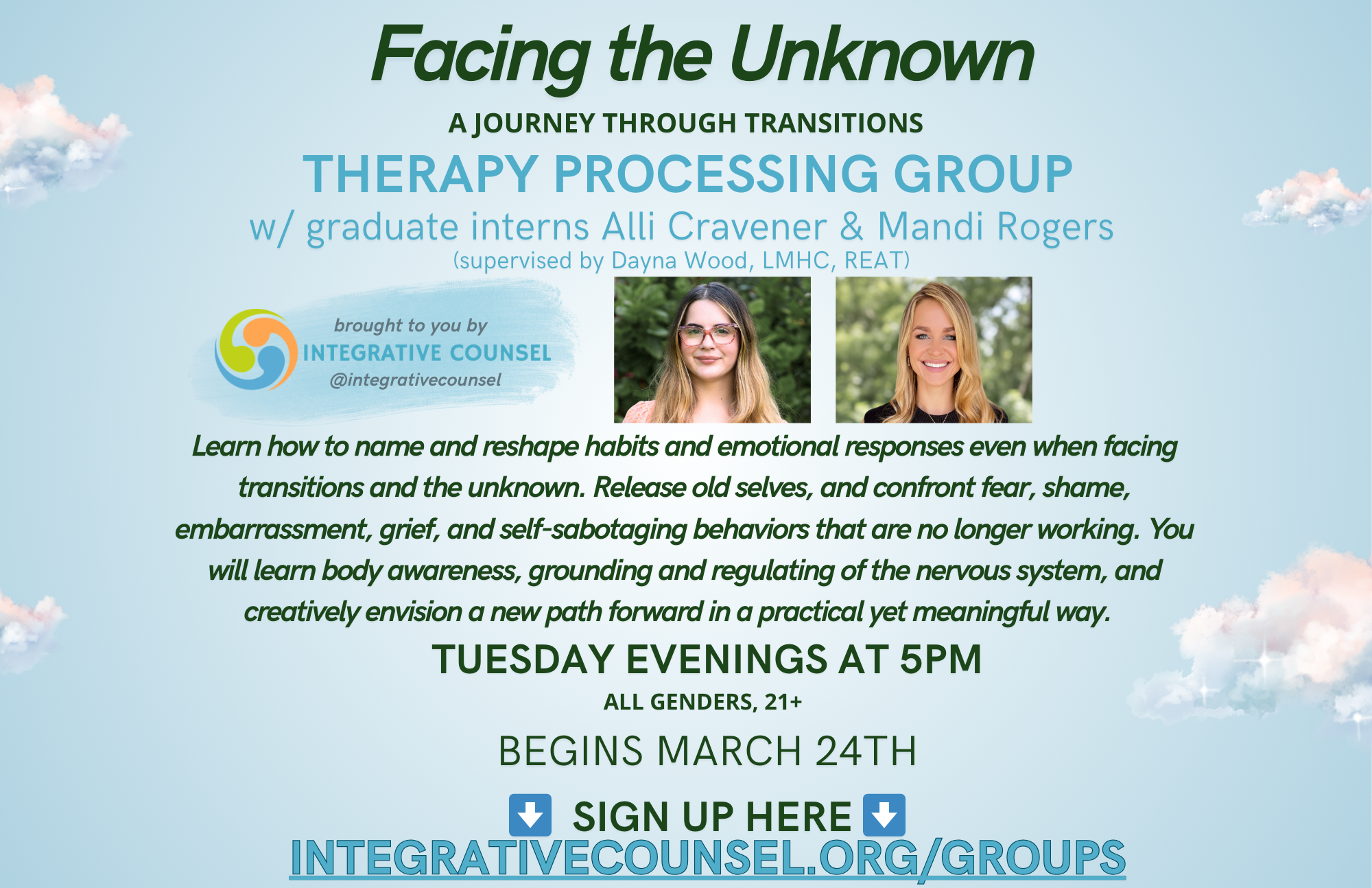
The setbacks are part of the phase of the journey in which you cross the threshold. As human beings, we are scared of the unknown, and it’s easy to get caught up in our own fight-or-flight response. If you are finding yourself in that space — between what was and will be — you don’t have to navigate it alone.
A Journey Through Transition is a therapy group designed to support you through these exact moments. This group focuses on releasing old patterns, working through fear, grief, and uncertainty, and developing a deeper awareness of your emotional and bodily experience. Through guided reflection, grounding practices, and creative exercises, you will learn how to move through internal challenges and begin forming new, more aligned ways of being.
It is a space to slow down, listen inwardly, and intentionally step into the next version of your life with clarity and support.
Click here to learn more and sign up.

Sunny Ebsary is an educator, multi-modal artist, and writer specializing in the intersection of myth and mental health. Sunny’s writing walks the line between poetic and logical, giving readers a chance to interface with the mind and imagination. Sunny’s been putting pen to paper since he was a child, writing everything from albums, novels, and plays, to essays, interactive games, and of course, many articles! While studying both psychology and writing, he realized his real passion in life was helping others unlock their creative spark. Whether he’s leading a D&D game, directing a production, or diving deep into the brain, you can be sure Sunny will be ushering you toward finding meaning in your life.
Click here to book a consultation call and start navigating your personal path to mental harmony with a therapist who gets you. Your journey, your pace, your story—let's unfold it together.
Let's keep the conversation going.
Feeling the spark to light up your wellness journey?